For therapists and counsellors · Windows · one-time purchase

Dictate a session note without uploading the session.

Every transcription service works by sending your audio to a server, which is why most therapists who would gain most from dictation do not use it at all. Session Notes ships the speech models inside the download, so you speak and the words appear on the machine in front of you, and nothing a client said goes anywhere. Around it sits the rest of a practice: your caseload, your week, a mental status exam and standardised measures, and a written record encrypted with a passphrase only you know. The application makes no network requests of any kind, and it costs fifteen dollars once.

One payment. No subscription, no account, no per client pricing, no renewal.

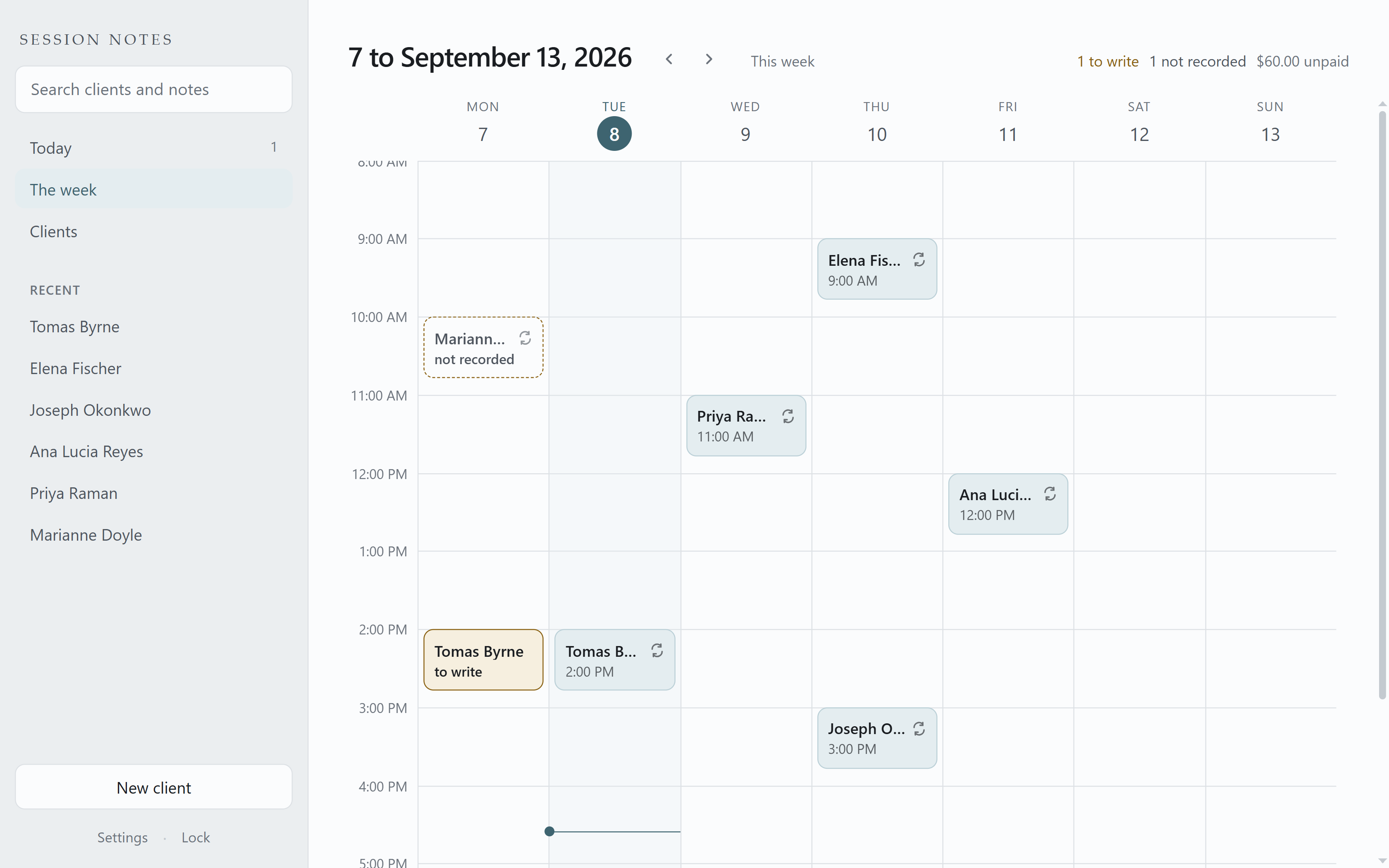
The week view: a seven day grid with appointments laid out by time, one highlighted in amber and labelled "to write", one drawn with a dashed outline and struck through, labelled "cancelled", and a heading reading "1 to write, 180.00 unpaid".
The week, and what you have not written up yet. The hard question at the end of a day is not what was on. It is which notes are still owed. Unwritten ones are the loudest thing on the screen, cancellations stay visible instead of turning back into empty hours, and every state carries a word as well as a colour.
Dictation on your own machine

Three speech models ship inside the download, so you can trade speed against accuracy without connecting to anything. The audio goes to a process on your own computer and never anywhere else, and you decide whether it is kept.

No network code

Not a setting you can leave switched on. There is no code in the application that opens a network connection, and the build refuses to compile if any is added.

Encrypted with your passphrase

AES-256. The key is derived from your passphrase and nothing else, so a stolen laptop is a stolen brick without it.

Bought once

No subscription, no account, no per client fee. There is no meter to raise later and nobody who can change the terms.

What it does

The record, the week, and the writing.

Four things and no more: the people you see, the appointments you keep, the notes you write, and the documents you attach. Everything else a practice management subscription sells you is deliberately absent, and the price reflects that.
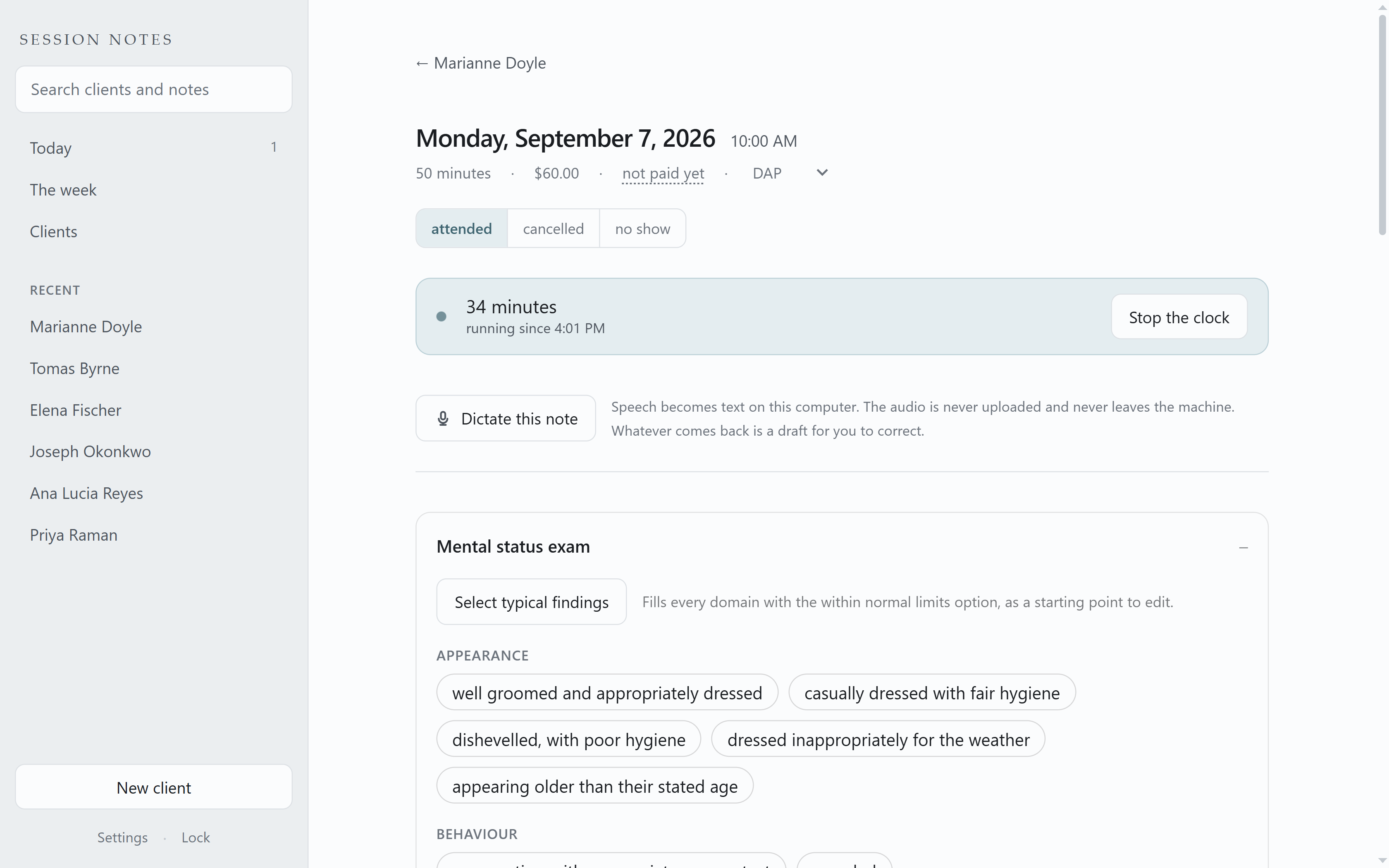
A session note with headings Data, Assessment and Plan, a quiet strip above it reading 34 minutes and running since 12:01, and a Dictate this note button at the foot of the page.
A page to write on, not a form to fill in. The note is set in a serif at a reading width, because you will write six paragraphs here at the end of a long day and read them back a year later in supervision. The clock runs quietly in the corner and records how long the session actually took. It proposes the length. It never changes what you charge on its own.
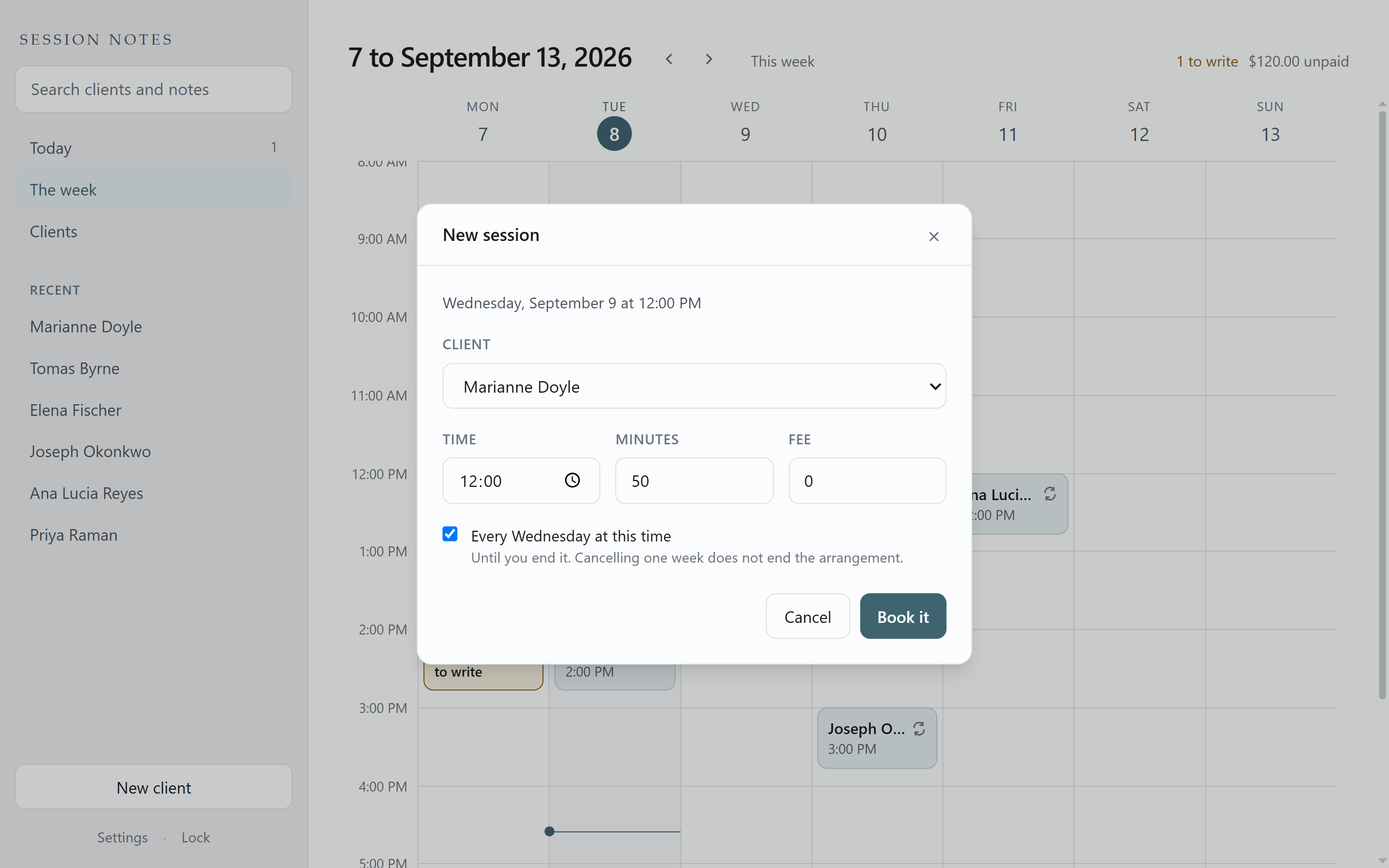
A new appointment dialog with a client, a time, a length and a fee, and a checked box reading "Every Friday at this time" with a note that cancelling one week does not end the arrangement.
Standing weekly slots, because that is how a caseload works. Almost every appointment repeats at the same time every week until it does not. Booking one is one click, cancelling a single week leaves the rest of the run alone, and ending the arrangement is a separate thing you have to mean.
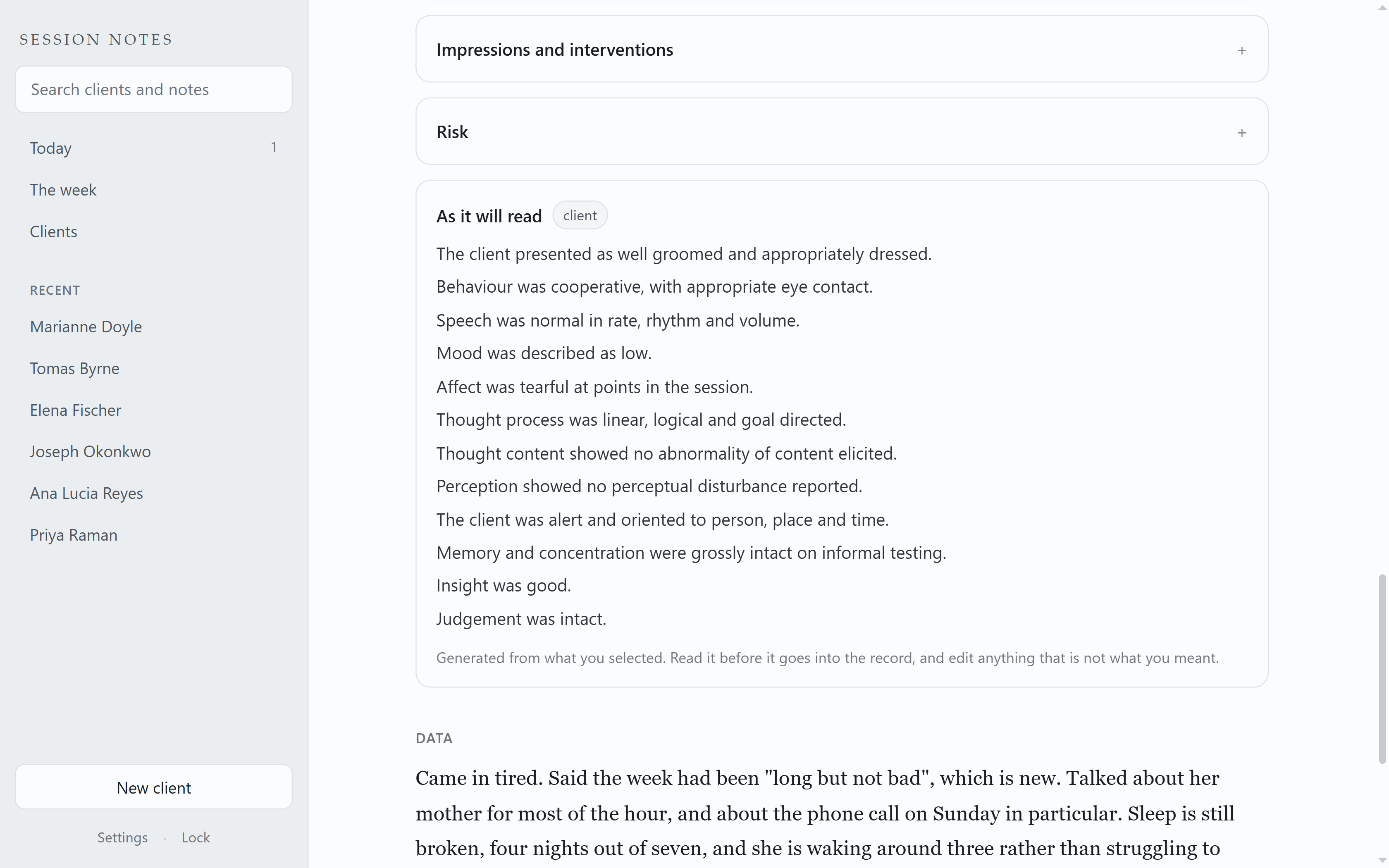
The generated clinical paragraph, listing twelve mental status exam findings in plain sentences, above the written note.
Click what you observed. It writes the paragraph. Twelve mental status exam domains, standardised measures scored against their published cut points, impressions and interventions. It will not let a note contradict itself, and it never rates risk.
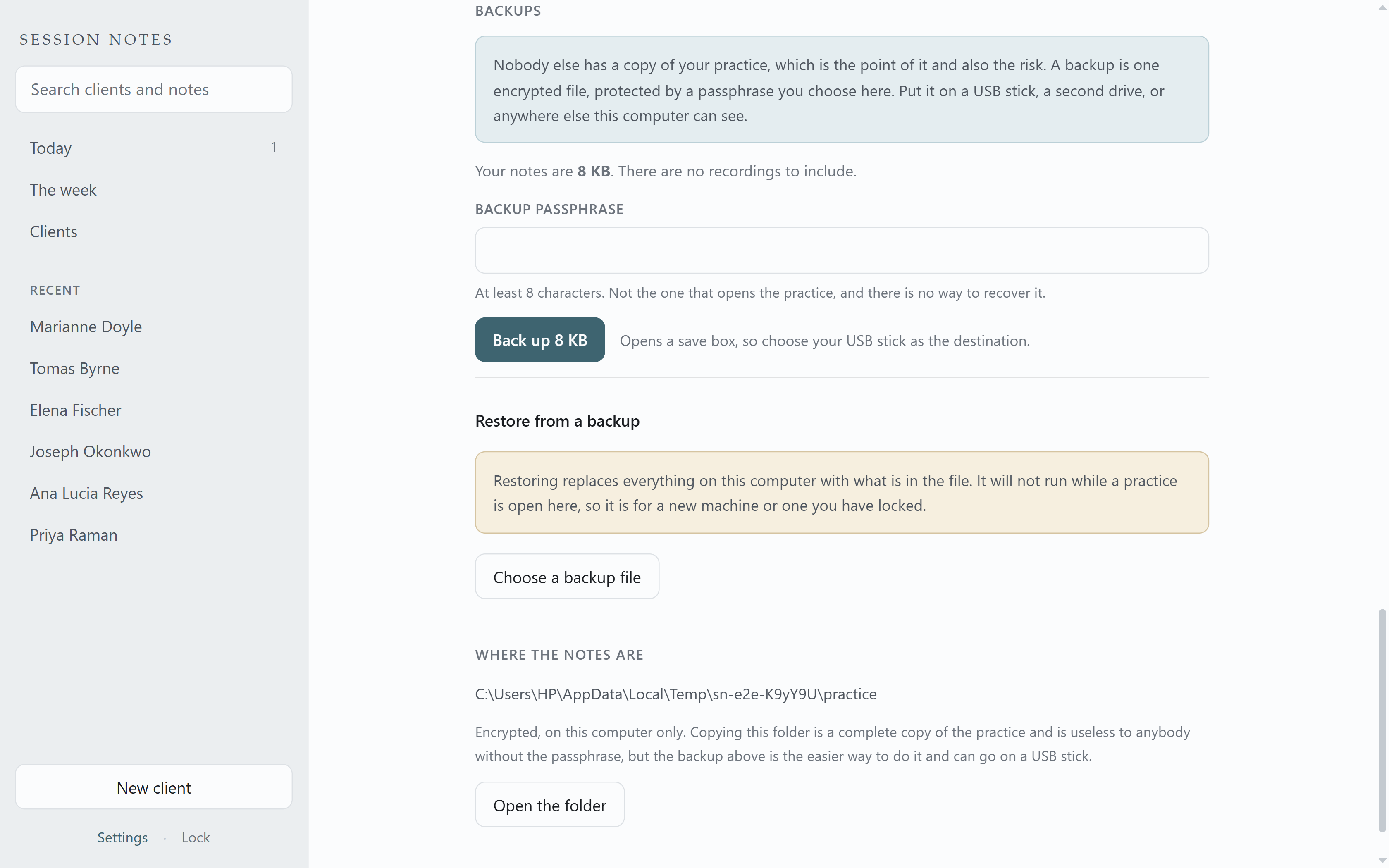
The backup panel, showing the size of the notes, a passphrase box and a button reading Back up 8 KB.
One encrypted file, on a USB stick. Nobody else has a copy, which is the point and also the risk. It shows you the size before you choose, and leaves recordings out unless you ask for them.
Dictation

Speak the note. Nothing leaves the room.

This is the part no cloud product can copy honestly. Otter, Rev, Word dictation and every other transcription service works by uploading your audio to somebody else. You cannot do that with a session, which is why most practitioners who would benefit most from dictation do not use it at all.

Session Notes ships three speech models inside the application. When you dictate, the audio goes to a process on your own computer and comes back as text. Nothing is uploaded, because there is nowhere for it to be sent and no code that could send it.

A note takes a few seconds to transcribe, faster than it took to say. You can send the window to a small strip in the corner of the screen while you talk, the way a screen recorder does, so you can look at something else without wondering whether it is still listening. That strip deliberately carries no name and no clinical detail, because it floats above whatever else is on screen.

The recording is kept, encrypted with the same passphrase as the notes, because the transcript is a draft and the only way to settle what was really said is to hear it again. That is a thing only local software can offer you. A cloud service holding a year of your session audio is a liability for both of you, which is why the honest ones delete it and the careless ones do not. Here it is a file on your own disk: play it, delete that one, or sweep everything older than a month in one go. You can also turn it off for a single note from the dictation row, or for good in settings.

If you have an accent that transcription software usually mangles, this is the part that matters. There is no accent setting here, because no such thing exists: one model covers every English accent and the only thing that changes is how much of it the model can hold on to. So the application ships three, from a fast one that is fine on clear speech in a quiet room to a slow one that gets difficult audio right, and you pick. It starts you on the middle one, which is still faster than you spoke. They are all in the download and none of them needs a connection.
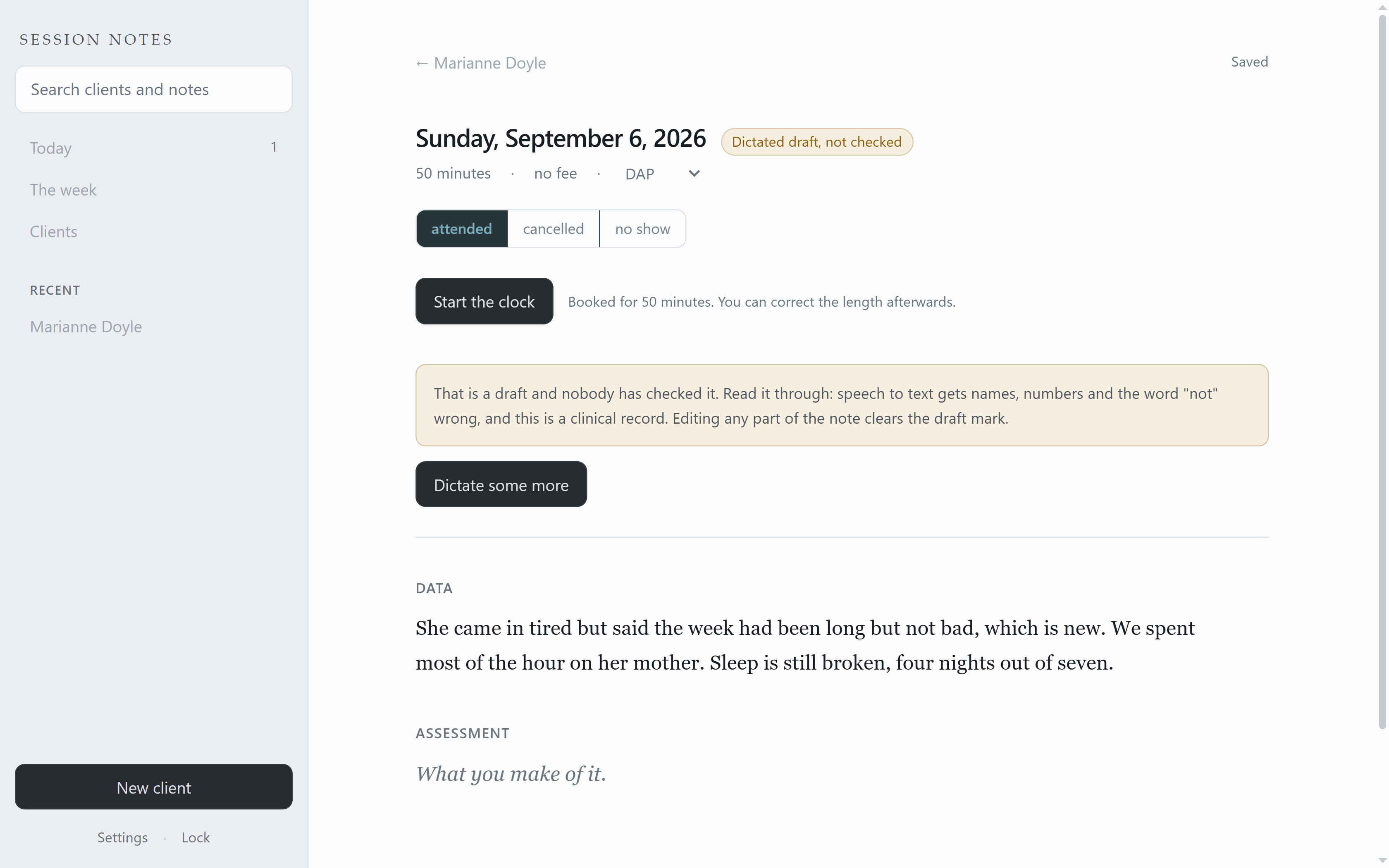
A session note just after dictation, with an amber badge next to the date reading "Dictated draft, not checked", a warning that speech to text gets names, numbers and the word "not" wrong, and the transcribed paragraph underneath in the Data heading.
What comes back, and what it is labelled. This is a real transcript from the model that ships in the application, not a retouched one. It even contains a mistake: the speaker said "four nights out of seven" and it wrote "for nights out of sleep". That is the reason the note carries a draft mark until you have read it through, and the reason no honest seller will tell you their transcription is accurate enough to sign unread.
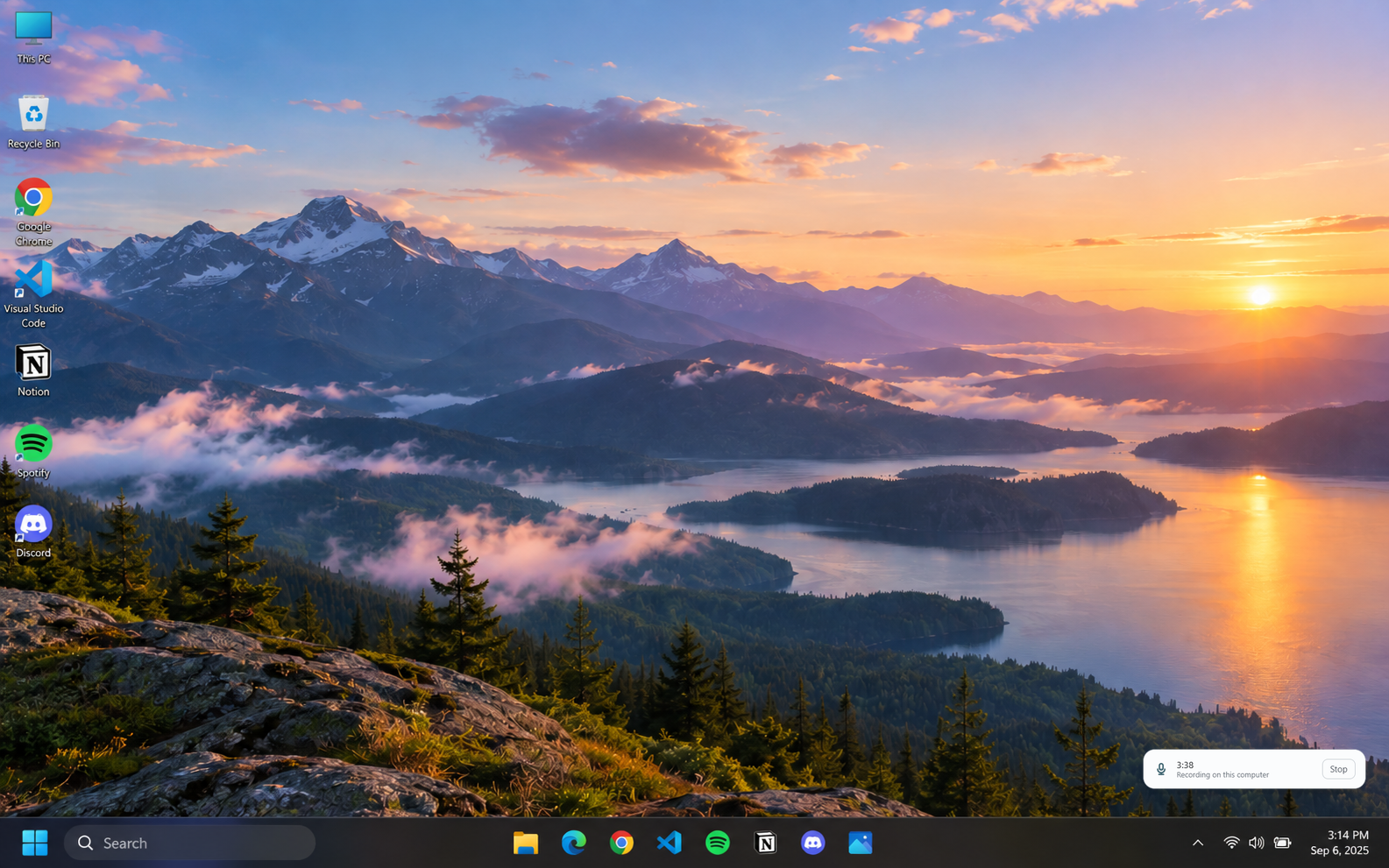
A desktop with the note window minimised to the taskbar, and a small strip floating in the bottom right corner reading three minutes thirty eight, "Recording on this computer", and a Stop button.
Out of the way, and still obviously listening. Send the window away while you talk and the recording keeps a small strip on top of everything else, the way a screen recorder does. It carries the time and a stop button and nothing else. No name, no date, no note text, because it sits above whatever is on your screen and that might be a shared one.
What comes back is a draft, and the application says so.

Speech to text gets names, numbers and the word "not" wrong, and those are exactly the words that matter in a clinical record. A dictated note is marked as an unchecked draft until you edit it. Read it through every time. Anybody who tells you their transcription is accurate enough to sign unread is selling something.

Not only therapy

It speaks sixteen other trades as well.

It is built for therapy, and the mental status exam, the impressions and the standardised measures are there because a therapist needs them. But the record underneath is the same shape for anybody who sees the same people repeatedly and writes something down afterwards. Pick your trade on the first screen and the words, the note format, the default appointment length and the fields all change to match. A physiotherapist never sees a mental status exam, and a counsellor never sees a body chart.

The words are the least of it. A physiotherapist records the body area treated, and that belongs to the appointment rather than to the patient, because it is a shoulder this week and a knee next week. A tutor records the subject and a table of topics with the homework set against each. Whatever your trade needs and nobody thought of, you can add yourself: a field on the person, a field on the appointment, or a table that repeats. Everything is searchable, and none of it is a different version of the application.

If yours is not on the list, choose Something else. Nothing is missing, you just keep the neutral words.
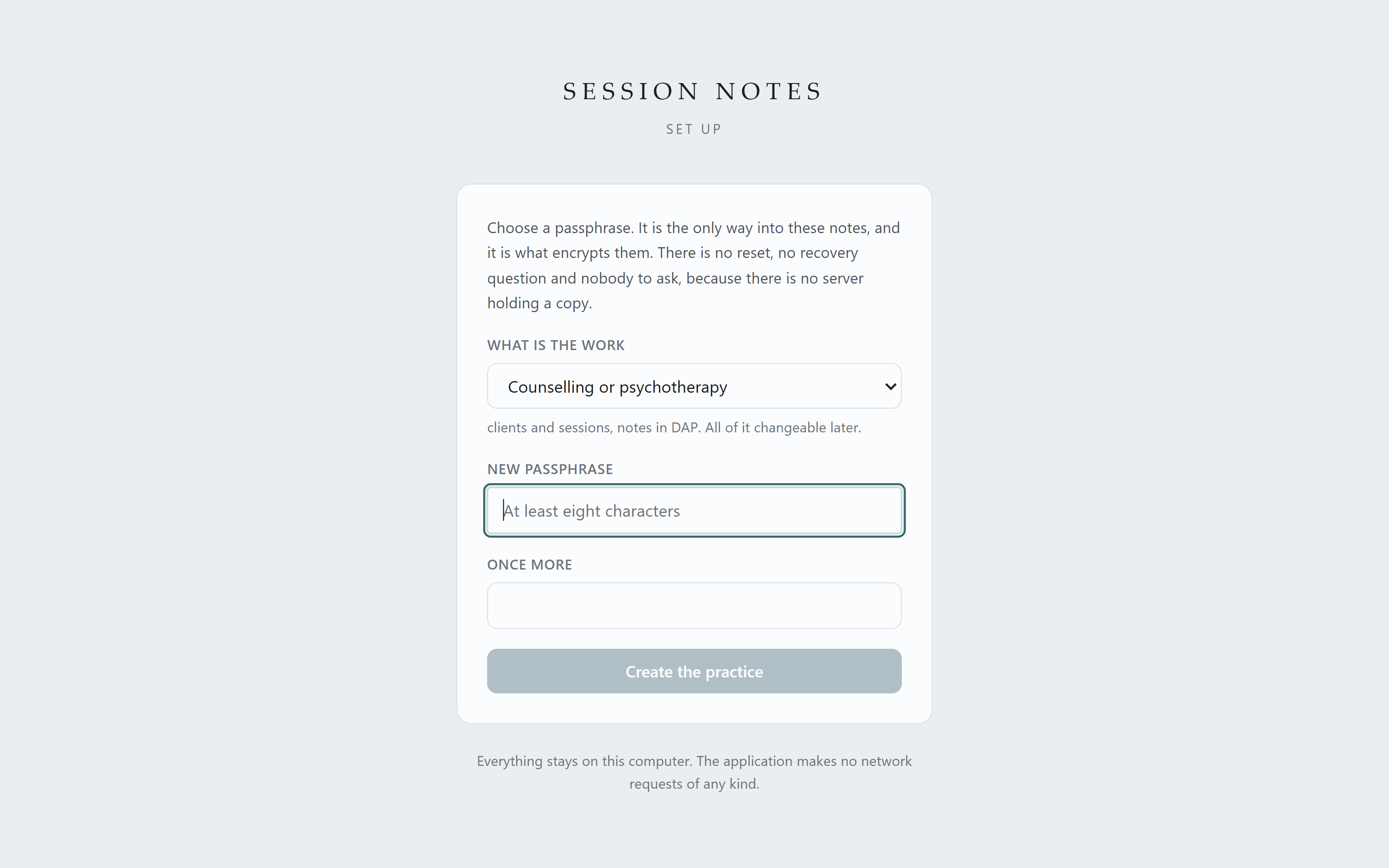
The first run screen, asking "What is the work" with a dropdown set to Counselling or psychotherapy, above a passphrase field.
It asks what you do before it asks anything else. Choose your trade and the application uses your words. A physiotherapist sees patients and appointments, a tutor sees students and lessons, a counsellor sees clients and sessions. It also picks the note format your trade actually uses and the fields you are going to want. All of it is changeable afterwards.
Compare

Against a notebook, and against what you are probably paying for.

The honest comparison, including the places where the subscription wins. If you bill insurance electronically, take card payments through your notes software, or need a client portal, the cloud product is doing work this does not do and you should keep it.

Feature Paper or Word Cloud practice software Session Notes
Notes stay on your own machineYesNoOn their servers, by designYes
Encrypted at rest with a key only you holdNoPartlyEncrypted, but they hold the keysYes
Searchable across every noteNoYesYes
Dictation without uploading the audioNoNoYes
Works with no internet connectionYesNoYes
Price stays where it startedYesNoRaised for existing customersYes
Keeps working if the maker disappearsYesNoYes
Insurance claim submissionNoYesNoNot built and not planned
Card payments and client portalNoYesNoNeeds a server, so no
Reaches you on your phonePartlyYesNoOne Windows computer
Limits

What it does not do, before you find out yourself.

All of these are deliberate. Most of them follow directly from the notes never leaving your computer, and none of them are going to change in version 1.

  • Windows 10 and 11 only. There is no Mac build, no Linux build, and no phone app.
  • One computer. There is no sync, because sync means a server and a server means your notes are somewhere else. Two machines means two separate practices.
  • No insurance billing, no claim submission, no superbills, no card processing and no client portal. If you need those, this is not a replacement for what you have.
  • No appointment reminders to clients. There is no way to send an email or a text without a network, and there is no network. Reminders are for you, on your machine.
  • If you lose the passphrase, the notes are gone. There is no reset, no recovery question and nobody to ring, because there is no copy anywhere else. That is the same property that makes a stolen laptop useless.
  • Backups are yours to remember. There is a one click encrypted backup you can write to a USB stick or a second drive, and a restore that puts it back on a new machine, but nothing runs it on a schedule and nothing nags you. If you never make one and the disk dies, the notes are gone.
  • Dictation is English only for now. All three models ship inside the download, which is most of the reason it is 884 MB.
  • Recordings take about 14 MB an hour, so a full caseload adds up over a year. Nothing is deleted for you unless you ask: there is a sweep for anything older than a week, a month or a year, and a delete on each note.
  • A recording is more sensitive than the note you write from it. It carries your client's voice, their exact words, and everyone they mention, and it can be requested in the same ways a note can. Whether to keep one, and whether you have consent to, is your judgement and not a setting.
  • It is not certified, accredited or audited by anybody. It is a program written by one person, and the source of that claim is the fact that no code in it opens a socket.
Price

About a week of what you are paying now, once.

Practice management subscriptions for solo practitioners run from about 50 to 100 dollars a month, plus a percentage of every card payment and a fee per claim. This is fifteen dollars, once, and then nothing. There is a free edition to try it on real work first: it holds three people on your caseload, has every feature switched on, and never expires. If you buy the full edition later, the practice you have already built opens straight up in it and nothing needs moving or re-entering.

$15once, including every 1.x update. Free edition, three people, no time limit
  • Everything the free edition has, without the limit on how many people you see
  • Dictation and the speech model included, not an add on
  • Every update within version 1 at no cost
  • Use it on your own computers, no licence server to check in with
  • Keeps working forever, including after you stop paying attention to it
  • A portable build that runs from a folder without installing
Download the free edition Get Session Notes

A major version 2 with substantial new work would be a new purchase, and it would be optional. That is said here rather than discovered later, because a perpetual licence with unlimited free work behind it is how small software companies quietly die, and a product that dies is worse for you than one that charges again in three years.

Questions

The things people actually ask.

Is it HIPAA compliant?
HIPAA compliance is a property of your practice, not of a piece of software, so nobody can honestly sell you a compliant application. What is true here is more useful: the notes never leave your computer, so there is no server of ours to breach and no employee of ours who can read them. Because we never receive, store or transmit your client data, there is no business associate relationship and no business associate agreement to sign. If your insurer or your board requires a signed BAA from every vendor as a matter of policy, that is a real obstacle and you should check before buying.
What about GDPR, or the UK and EU rules?
Keeping personal data on your own encrypted machine, with no processor involved, is a straightforward position under GDPR. You remain the controller, there is no processor to name, no international transfer, and no sub processor list. You still owe your clients the things you always owed them: a lawful basis, a retention period, and the ability to produce their record if they ask. This application makes that last one easy and does not affect the rest.
Where exactly are my notes?
In one encrypted file in your Windows user folder, and the settings screen shows you the exact path and will open it for you. Copy that folder and you have copied your whole practice. The file is useless to anybody without your passphrase, so you can back it up to a USB stick or a cloud drive without giving away the contents.
How do I know it is really offline?
Three ways. Unplug the network and use it, which is the test that matters to you. Run it behind a firewall that logs outbound connections and watch nothing appear. Or note that the application blocks its own window from making any request that is not local, the transcription process has its network functions removed before the model is even loaded, and the build fails if anybody adds networking code to the source. It is a claim built to be checked rather than trusted.
Is the dictation any good?
On clear speech in a quiet room, dictating deliberately into a decent microphone, it is very good. On a mumbled sentence with a fan running it is worse, which is why three models ship and you can change to a slower, more careful one when the audio is difficult. Published error rates for models of this kind on real conversational English are roughly five to ten words in a hundred, and dictation is the easy end of that range. Every transcript is marked as an unchecked draft until you edit it, and you should read every one. The recording is kept so you can check it against what was actually said.
Does it keep the audio?
Yes, encrypted with the same passphrase as the notes, and you can turn that off. It is kept because the transcript is a draft and hearing it again is the only way to settle what was said. This is the one thing local software can offer that a cloud service cannot: your audio is a file on your own disk rather than a year of session recordings sitting on somebody else's server. Delete one from its note, sweep everything older than a month, or switch it off entirely and only the text is kept.
Can I try it first?
Ask and you will get a straight answer about whether it fits your practice, including a recommendation not to buy it if it does not. There is a refund if it turns out not to work for you.
What happens when Windows changes and it breaks?
Fixes for version 1 are free for as long as version 1 is supported. The honest version of this answer is that this is made by one person, so if you need a support contract with a response time, this is not the right purchase.
Why is the download so large?
It is 884 MB, and almost all of that is three speech models. Cloud products keep those on their servers, which is exactly why they need your audio. Downloading them once is the price of never sending a recording anywhere, and it is a one time cost: the application never fetches anything again, because it has no code that could.
I am not a therapist. Is it still for me?
Probably. It suits anybody who sees the same people repeatedly and has to write something down afterwards that ought to stay private. Seventeen trades are offered on the first screen, from physiotherapy to tutoring, and choosing one changes the words and the note format to match. If yours is not listed, the neutral words work fine.